
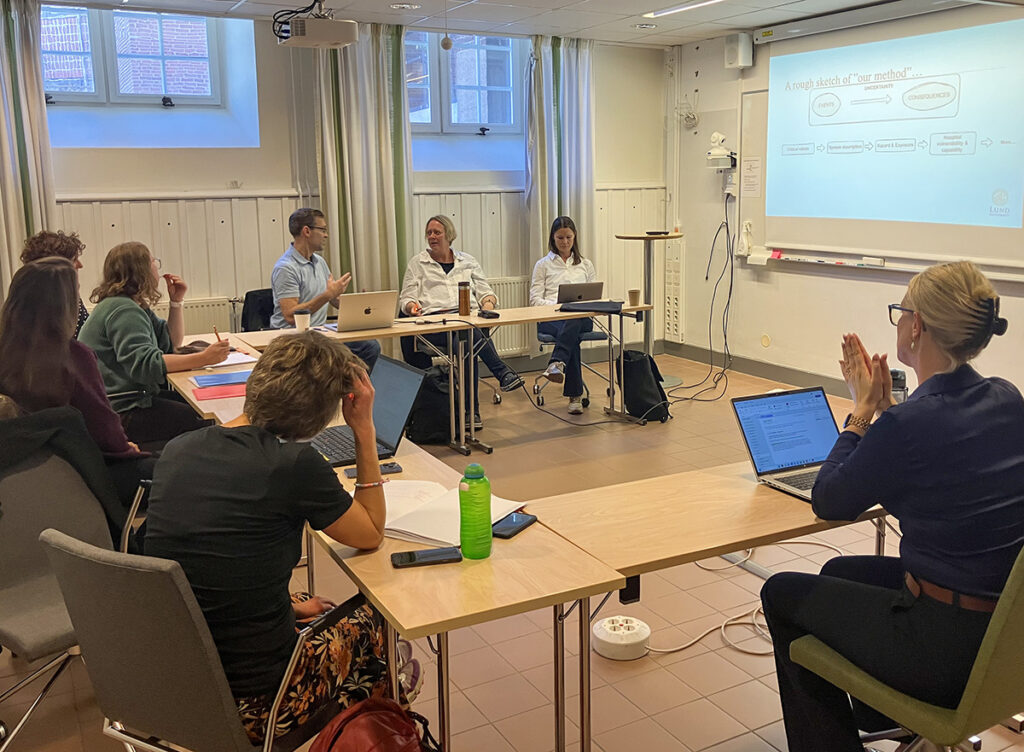
The meeting was organised as part of Work Package 2 of the project, which focuses on risk and needs assessments. Researchers and professionals from Lund University, Region Skåne and other project partners took part to clarify how the project should assess hospitals’ vulnerability to flooding.
One important point raised at the meeting was that a risk assessment should do more than identify where water may accumulate. The key is to understand when and how water could affect a hospital’s critical functions and, in turn, its operations.
The project is therefore now working to identify the functions that are essential for a hospital to remain operational during a climate-related incident. These may include the emergency department, operating theatres and intensive care units, electricity supply, IT and communications, water supply, the central sterile services department, and the logistical infrastructure supporting activities such as blood tests, food and linen deliveries.
A method that can be used at other hospitals
The meeting also addressed how to define the scope of the assessment so that it is sufficiently specific while still providing a basis for a method that can later be applied at other hospitals.
Malmö Hospital was discussed as the Swedish case study, partly because a good body of data is available and because the hospital faces specific challenges that the project can explore further. The next step will be to link knowledge of flood risks with the hospital’s critical functions and existing emergency preparedness arrangements.
The aim is not simply to build a picture of where hospitals are vulnerable. The work should also generate knowledge about which risks should be prioritised and which preventive and organisational measures may be relevant to develop. This will help ensure that staff are better prepared to deal with climate-related challenges and that hospitals become more resilient.
From analysis to action
The risk and needs assessment is an important part of the overall KiS project. Its findings will later feed into the project’s work on collaborative networks, policy, governance and long-term integration.
The aim is not merely to identify climate-related risks, but to provide knowledge, recommendations and tools that can help hospitals in both Denmark and Sweden prevent and manage the consequences of extreme rainfall and flooding – thereby strengthening their climate resilience.
The work will now continue in Sweden, with the project team taking a closer look at the hospital’s functions and physical characteristics. Similar work will later be carried out in Denmark, allowing experience and methods to be developed and refined across the Øresund region.

